Tuesday, April 28, 2015

Southwest Sampler

Indian Paintbrush in the Coyote Buttes Wilderness, Arizona

If this were a food blog and you saw the title of this post, you would probably be thinking about some delicious enchiladas or perhaps an exotic mole sauce was coming up! Well, we did visit the southwest recently and did have some great Mexican and Native American food along the way. But alas, the sampler here is limited to flora rather than flour, and focuses on a few early blooms as opposed to a local gourmet menu.

Our trip was centered around getting to "The Wave" rock formation in northern Arizona on April 8. That's the day we had a permit to do this remarkable hike. So we planned a southwest loop trip, as getting there from northwest Oregon is a major endeavor. On the loop, we visited Zion, Grand Canyon, Monument Valley, Four Corners, and the San Juan mountains of southwestern Colorado as well. To see photos of The Wave formation, follow the link below.

For this post, I'll include plants we found in the high deserts of southern Utah and northern Arizona. The elevations and terrain varied from about 3,000 - 7,000 feet in these desert areas, and the natural landscape colors were splendid, causing frequent stops for scenery photos as well as for flowers.

The weather during our visit to this area was mostly sunny and dry, but we did encounter windy days in several areas. Our first days in Zion and Page were nice and warm, but turned much cooler as a cold front moved in. Some strong winds were associated with that front. Fortunately, the weather was mostly favorable for our hikes and travel days.

This post shows our favorite blooms we saw in each area and you can follow the link below to see all of the photos. I was surprised by the sheer numbers of blooms we saw; as well as the plethora of Evening Primrose species and Milkvetch. I had no idea either of these plants had desert cousins.

Meanwhile, I've done my best to identify at least the genus of these plants, but some will take longer, as I learn more about these desert dwellers.

Utah Penstemon and Prickly Pear Cactus
 at Zion National Park

Prickly Milkvetch at Zion National Park

Gooseberry-Leaf Globemallow near St. George, UT

Pale Evening Primrose in the Coyote Buttes Wilderness

Now before I head out to Baja Fresh for a monster "two hands" burrito and Negro Modelo, just want remind everyone of the Cinco de Mayo date that is soon approaching. Hasta la vista!

Links:


Desert Wildflower Gallery

The Wave Gallery


Sunday, April 5, 2015

Stumped


Part of the enjoyment of my wildflower hobby is learning about botany, flowers, and nature in general. It's a lot more fun doing this as a hobby than say, taking a college class and getting tested on the minutia of details real students must learn. And the price is right as well! Over the past two years, I have learned a great deal from this exercise and I have come to appreciate those early explorers in the plant world such as David Douglas, William Clark, and Meriwether Lewis.

Most of those esteemed gentlemen had a good deal of knowledge of the day when they were on their expeditions, but they were not botanists. And of course they were focused on many other things besides finding new plants - such as staying alive!

In the case of Lewis and Clark, all of the plants they could not readily identify were sketched, documented, pulled up, and sent back to experts in Washington D.C. between 1804 and 1806. Here, botanists, horticulturists, and others examined the samples and tried to identify them. They sent back over 200 plant specimens and are credited with discovering 174 new plants, unknown to science at the time. That's an amazing feat, and you can still see some of these samples at The Academy of Natural Sciences in Philadelphia. Douglas made three separate trips to the Northwest in the 1820's and is credited with bringing 200 plants back to England. These specimens were then examined and fully identified by the leading botanists of the day.

Well, coming back to the present and my small hobby, I don't take samples per se as I wander about admiring the flora. Just photos and at times some notes to help me remember the setting. For identification, my expert helpers are about a dozen books and websites that make up a wide swath of accumulated knowledge.

When I go out for a walk or hike, I bring along my camera and capture any unfamiliar blooms or interesting plants. Then back at home, in the comfort of my study, I spend anywhere from half an hour to several days nailing down the plant ID. But even with this wealth of knowledge at my fingertips, there are some findings I simply cannot identify, hence the title of this post.

I suppose it's a good thing some of these captures remain elusive. After all, we humans always need a carrot to reach out to in our next quest.

Here are the three stumpers for 2014 - if you know these guys, call my hot line!

Unknown #1: observed 5/07/2014 at Devil's Churn near Cape Perpetua
on the Oregon coast. Nickel sized flowers with waxy leaves.
Growing on southern cliff near the trail down to the churn.

Unknown #2: as found on 5/23/2014 on Holly Hill Road. The
pea-like blooms are in clusters. Branches have prolific thorns.
The large shrub stands about 8 ft. tall and it seems to be spreading.
Probably and invader of some kind, resembles pea family.

Unknown #3: weedy plant with 1/3 in. flowers.
Found on 6/20/2014 on Laurelview Road.
Plant is about 10-12 in. high. Growing in
disturbed area along road. 

Monday, March 23, 2015

Narcissus

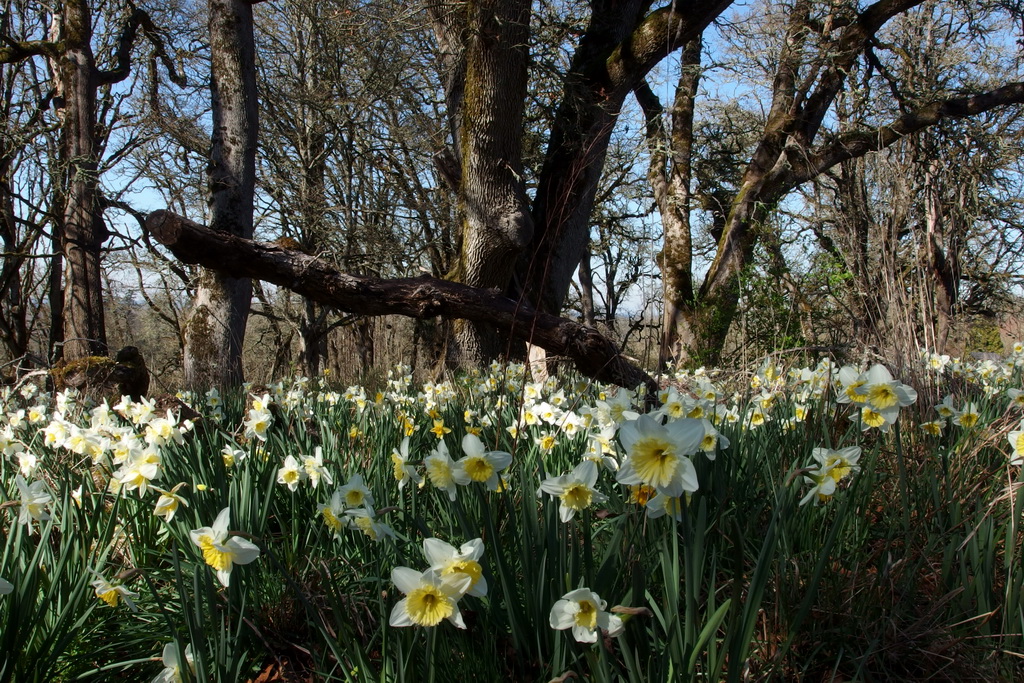
Naturalized Narcissus under Oregon White Oaks

As a youngster in western Oregon I did not pay much attention to the flora around me. But I do remember the wonderful, colorful daffodils coming up in spring, like little flags waving in celebration. We moved away when I was six, to a totally different climate and geography where there were no spring bulbs. It was not until 25 years later when we visited Oregon at the height of the bloom that I realized what I missed. It rang up a happy childhood memory, kind of like the big ice cream cones my Grandmother used to give us!

Landscaped Daffodil Island

The daffodil name has come to mean one of about 50 species in the Narcissus genus. None are native to the Northwest, and as you can imagine, have been extensively hybridized over the years. Linnaeus first described Narcissus as a genus in 1753, but the ancient Greeks were familiar with the plant as well. And if you remember your Greek mythology, you'll know that Narcissus was a good looking fellow who was so taken with his reflection in a pond that he was unable to save himself from the waters.

That story does have some truth in that all members of the genus are highly toxic and can be poisonous to humans and animals alike. This would explain why the deer and gophers leave them alone around our place!


Small daffodils or large cat?

Here in our corner of the world, there are some "wild daffodils" that have become naturalized. These are Narcissus pseudonarcissus and look similar to many of the hybridized products you can purchase at the local garden shop. They are native to western Europe but are naturalized all over the northern hemisphere. You've probably seen them growing in natural fields, along country roads, or on hillsides.

All Narcissus have six petals and a trumpet!

Although we love "daffodils" in general and have about a dozen different varieties growing around our property, my favorite is the Narcissus poeticus, sometimes called Poet's Daffodil or Pheasant's Eye. It is native to central Europe. This daffodil is prized for its oil, which is used in high end perfumes. The plants are cultivated in France and the Netherlands for that purpose.

Poet's Daffodil

As you can imagine, growing and selling daffodils is big business around the world. Thousands of cultivars have been developed for our backyard gardens. I suppose no one is going to get tired of celebrating the end of winter, so new varieties of these bulbs will continue! There are numerous daffodil festivals in our area (Amity, Junction City, Pulyallup) and the American Daffodil Society has reams of information about all things Narcissus. 

In closing, I could not find a clear history of the daffodil name as it applies to Narcissus. Perhaps because the name Narcissus has some baggage (the Greek legend and the derived narcissism word), a different common name was chosen. Daffodil was also a name given to girls in the 1800's but fell out of favor due to the ease of shortening it to "Daffy." 

Links:


Friday, March 13, 2015

A Nod to Our Natives

If you live here in western Oregon, you already know this: our early spring has us nature lovers in a buzz! Not only are we enjoying a banner year for daffodils and other early garden blooms, but our native plants are also popping out left and right - I mentioned a couple of these in my last post and want to share a few more in this one. By the end of this month, so many natives will be blooming that I won't be able to keep up. But not to worry, my goal here is not to capture every possible bloom, but to relate the enjoyment of the journey and to gain some knowledge in the process!

It is also gratifying to know we live in a place where so many people appreciate the value and importance of native plants, their habitats, and are willing to act for their protection. I won't hop onto my planter box here, but in that vein, if you are in a planting mood, there are many resources available for choosing the best natives for your location.

There are a number of groups that host native plant shows, festivals, and sales in the coming months. The Native Plant Society of Oregon has a good list of these events on their website, under Wildflower Shows. Locally, Jackson Bottom Wetlands has a native plant sale coming up on April 18th. Portland Audubon has their sale on April 11 and 12 along with experts to answer any questions.

On to the photos now! These spring beauties are all growing in our local parks and/or natural areas, so you'll probably spot them as quickly as we did.

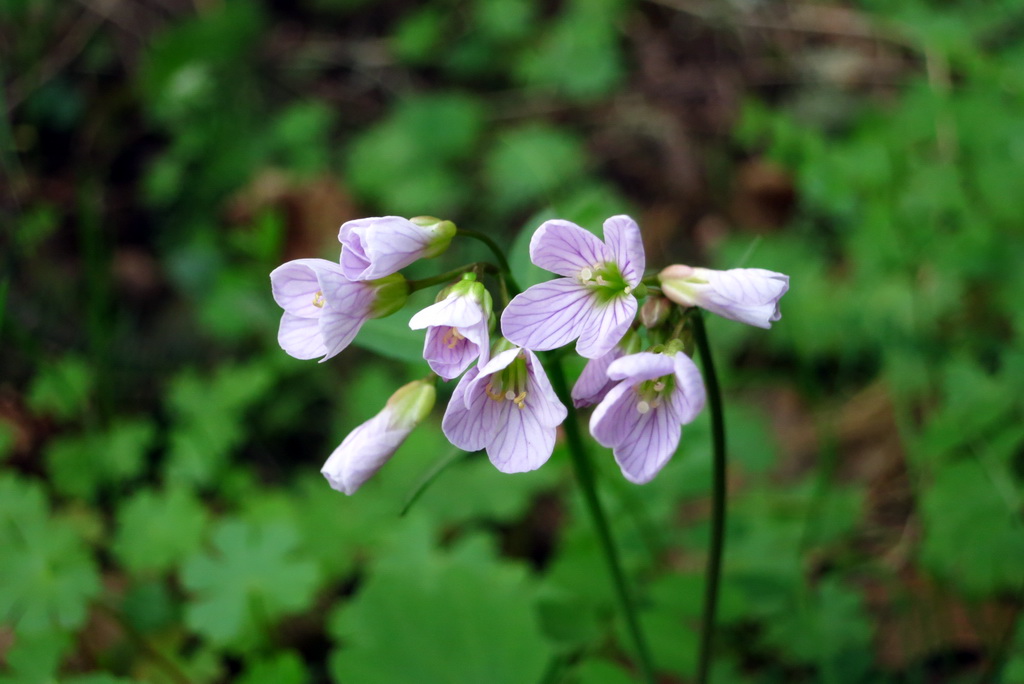
One of my favorite oddly named plants is small (4 - 8 in. high), has a wonderful subtle purple color, and can easily be missed if you are not looking for it: Oaks Toothwart (Cardamine nuttallii var. nuttallii). Lewis & Clark found it growing along the Sandy River on April 1, 1806. It's one of 44 species named after Thomas Nuttall, a U.K. botanist who lived in the U.S. from 1808-1841.

Oaks Toothwart - Cooper Mountain Nature Park - 3/05/2015

For sheer mass, color, and odor, the venerable Skunk Cabbage (Lysichiton americanus) is a local champion! Standing up to a foot tall, these bog dwellers resemble pop art periscopes - native tribes used the large leaves as a kind of wax paper for lining baskets, etc.   


Bog at Ecola State Park - 3/06/2015. Leaves are about a foot
 tall on these, but will get larger.

Skunk Cabbage Flower

Another early blooming highlight showing its stuff right now is the flamboyant Red Flowering Currant (Ribes sanguineum). This tall shrub is covered with bright red cluster blossoms and is somewhat of a celebrity. David Douglas sent seeds back to London where the plants grew and became an instant hit. It is said that The Royal Horticultural Society of London recouped its investment in his expedition from this plant introduction alone!


Red Flowering Currant - Oregon
 Garden - 3/09/2015

We found several Coltsfoot (Petasites frigidus) blooming at the coast, near a fresh water creek in Ecola State Park (3/06/2015). This was the first time we've seen these in bloom so we were struck by the large, softball sized flower clusters. These bloom later at higher elevations as well.


And last but not least, any school child in western Oregon can readily identify this forest favorite: Western Trillium (Trillium ovatum). With its three big leaves and three brilliant white flower petals, it jumps out from the semi-shady tree cover as if to say "look at me." The petals gradually fade to purple, adding to the allure of this noteworthy species.

At Noble Woods Park - 3/12/2015

At Noble Woods Park - 3/12/2015. Sword ferns in background.

Sunday, March 1, 2015

Apetala1 is Active!

With all the good weather we had in February it would be hard not to notice the Crocus, Daffodils, Vinca, and Hellebores in full bloom all over the area. These are blooming earlier than usual due to our on-going warm and dry period. Flowering Plum trees, Star Magnolias and several varieties of Camellias are adding their bright colors as well.

So how do these flowers know that it is time to bloom? We think the weather, length of day, soil temperature, and other factors are involved. But it was not until 2005 that botanists learned that the blooming process is actually controlled by the plant's DNA. A lone master gene called Apetala1 triggers the reproductive cycle of the plant, thereby starting the bloom process.

Aptala1 generates the proteins that in turn signal over 1000 other genes that are involved in the flowering process. The Apetala1 gene is essentially a bio-computer that gathers data from many other genes about external conditions and then executes a "bloom" command to get things going. Who knew it was this complicated? I certainly did not.

Meanwhile, in the wildflower world, we've noticed Indian Plum, Willows, Bittercress, Speedwell, Red Dead Nettle, and Oregon Grape showing their stuff. Indian plum (Oemleria cerasiformis) is one of our native early bloomers in the area. Hairy Bittercress (Cardamine hirsuta) is not native but is widely growing around the valley. Early willows at Jackson Bottom are opening their catkins and releasing pollen as well.

Even with the relatively warm days, the nights are still cold, so I don't expect the wildflowers to get too far ahead of the game. However, our snow pack numbers are very low for this stage of winter. Local meteorologists are saying the Mt. Hood area snow pack is a mere 9% of average this week. One possible upside to the lack of snow in the mountains is that the good hiking trails should be open sooner this year. We shall see. Here's a quick rundown of what we saw in the past week.

Indian Plum at Jackson Bottom: also called Osoberry, it produces small purple fruits in summer which was/is consumed by many native peoples and birds alike.


Hooker's Willow at Jackson Bottom: there are several dozen willows that can be found in Oregon and this is one of the early bloomers.


Hairy Bittercress in our yard: The leaf structure on these remind me of a snowflake, due to their symmetrical growth. The leaves have a peppery flavor and can be added to salad. The flowers are on a stalk about 3 inches above the leaves. The flower cluster shown below is about 1 cm wide.


Birdseye Speedwell (Veronica persica) in our driveway: First noted in the U.K. in 1825 this is one of hundreds of species in Veronica. The plant is now naturalized throughout the U.S. It's another tiny bloom that is hard to spot unless you get down close to the ground - like a bird!


Tall Oregon Grape (Mahonia aquifolium): I've posted on this native before, but of interest in this photo is the dark red holly-like leaves. It's common for Oregon Grape leaves to turn red in winter and then back to dark green in spring. Apparently at least part of this plant knows it is still winter!

Captured on 2/23/2015

Red Dead Nettle (Lamium purpureum): one of my favorites, because of its odd name and because the tiny flowers resemble orchids. The weedy, non-native has a long history of use as an astringent and diuretic among others.

Roadside Red Dead Nettle among Vinca, Storksbill,
and Cleavers: a weed forest in the making!

So to wrap up this time, let's hope for continued warm, dry weather. I'll be dusting off my other cameras and macro lens soon, ready for another season of exploring the natural world!

Friday, February 20, 2015

A Nut is Born

For the past few weeks, I have been reminded that our mild winter continues as the purple crocus pop up and the daffodils reach full bloom. Native plants like Indian Plum are also blooming. Then it hits me as I reach for the Cetrizine hydrochloride pills: the hazelnut tree pollen is back! It gives me fits every year as nature takes its course and the pollen is cast to the wind and sticks to me like a dusting of flour. I do love our little neck of the woods here in western Oregon but it is also the hazelnut orchard capital of the Northwest, and those of us with allergies do pay for that! But I still savor just about anything with hazelnuts, from cookies to coffee, so I grin and bear it between sneezes and try not to go nuts.

A few of last year's harvest from our Hazel tree.

Hazelnuts come from the deciduous Hazel tree which is in the genus Corylus. There are fewer than 20 species in the genus and only one is native to western Oregon, the Western or California Hazel (Corylus cornuta var. californica). Most orchards in our area are growing cultivars of Corylus cornuta. Because the nuts are so popular with birds and squirrels, as well as humans, the trees have spread outside of orchards, so you may have one growing in your backyard or might see them in our local natural areas. The naturalized Hazels tend to be large shrubs rather than trees.

Hazelnuts (or filberts as they are sometimes called) and humans go way back. There is evidence of hazelnut harvesting and processing some 9000 years ago in Scotland. I wonder if those natives had allergies?! On the bright side, the nuts are very nutritious, are easy to grow and harvest, and they keep well after harvest. According to OSU, the first planted hazelnut trees in Oregon were at Scottsburg in 1858. Currently, there are about 35,000 acres of cultivated trees in Oregon. Imagine how much pollen that is!

But more relevant to this post are the tiny female flowers on the hazel tree that emerge shortly after the pollen begins to rain down. This year they appeared about two weeks ago (2/10/2015).

In late winter, the trees begin to produce male catkins, which around here usually open up by the first week in February. Upon opening, that nasty yellow pollen is released to the air. Meanwhile, the tiny pinkish flowers emerge on the twigs near the catkins. These flowers look like miniature sea anemones and are about the size of a pencil eraser. The flowers draw moisture from the air, making them sticky and when pollen from the catkins lands on it, a nut is born, so to speak! The nut grows through summer and is ready to harvest in the early fall.

Modern hazelnut harvesting is a fascinating process unto itself, but I won't dwell on it here. You can look that up if interested. In the mean time, I'm tired of sneezing, so I'm heading out to get some hazelnut ice cream!

Male catkins ready to open. The catkin is
about 2 inches long.

Female flowers about two weeks after above photo.

Flower with opened catkin. 

Flower with bud.

Our tree has several hundred of these tiny but colorful flowers.

Links:

OSU Hazelnut Page

Oregon Hazelnut Health Benefits Site

OSU Extension Info About Hazelnut Orchards

Sunday, February 8, 2015

The Annual Moss Issue

Back by popular demand, it's the annual Moss issue! Don't worry, this post is not about swimsuits in the tropics - it's about that short green stuff that grows all over western Oregon in the winter shade - a.k.a., Bryophyta.  What's a card-carrying wildflower fanatic to do in January, but to resort to posting about low life, non-vascular plants like moss?! In fact, after several field trips capturing all manner of moss, I may start a new series called "Fifty Shades of Green."

Jackson Bottom Wetlands Preserve
Getting back to the subject at hand, one could ask, "what good is moss?" When it gets on your roof or in your lawn, you may take a dim view of moss and that is completely understandable. But moss does actually have a few good features, such as using it for plant DNA research; and for many commercial uses by florists, nurseries, and decorative gardens. And in a pinch you can use moss as a sponge! Dried peat moss can be used as a soil additive, insulation, and for growing mushrooms. For additional moss factoids, go to last year's issue (link below).

Even though we are having a warmer than normal winter in our area, the moss is doing quite well, as you can see by these photos, all taken in the past few weeks. As we did last year, a few of the photos are posted here - if you just can't get enough moss, please visit my photo website (link below) or better yet, take a walk in one of our local nature parks, where you will find plenty of moss!


T.H.N.P. 1/27     

"The Mother of All Moss Walls"

In closing, I'll leave you with "Moss," a poem by Bruce Guernsey, as seen on the Poetry Foundation website:
How must it be
to be moss,
that slipcover of rocks?—
imagine,
greening in the dark,
longing for north,
the silence
of birds gone south. 
How does moss do it,
all day
in a dank place
and never a cough?— 
a wet dust
where light fails,
where the chisel
cut the name.

Moss by Bruce Guernsey: The Poetry Foundation

Links:

2015 Moss Gallery

2014 Moss Issue