Friday, July 5, 2013

Water Parsley

Here's yet another member of the carrot family (Apiaceae)! This family has more than 3,700 species, with some being extremely poisonous, while others are served up daily!

The native Water Parsley (Oenanthe sarmentosa) blossom looks similar to many of the other family members, but the leaves are rather unique, and actually do resemble parsley! It prefers wetlands and marches, but can grow elsewhere. Oddly, I found these growing up at Bald Peak State Park, in a heavily shaded area that probably pools snowmelt. 6/29/2013.


Wednesday, July 3, 2013

Tiger Lily

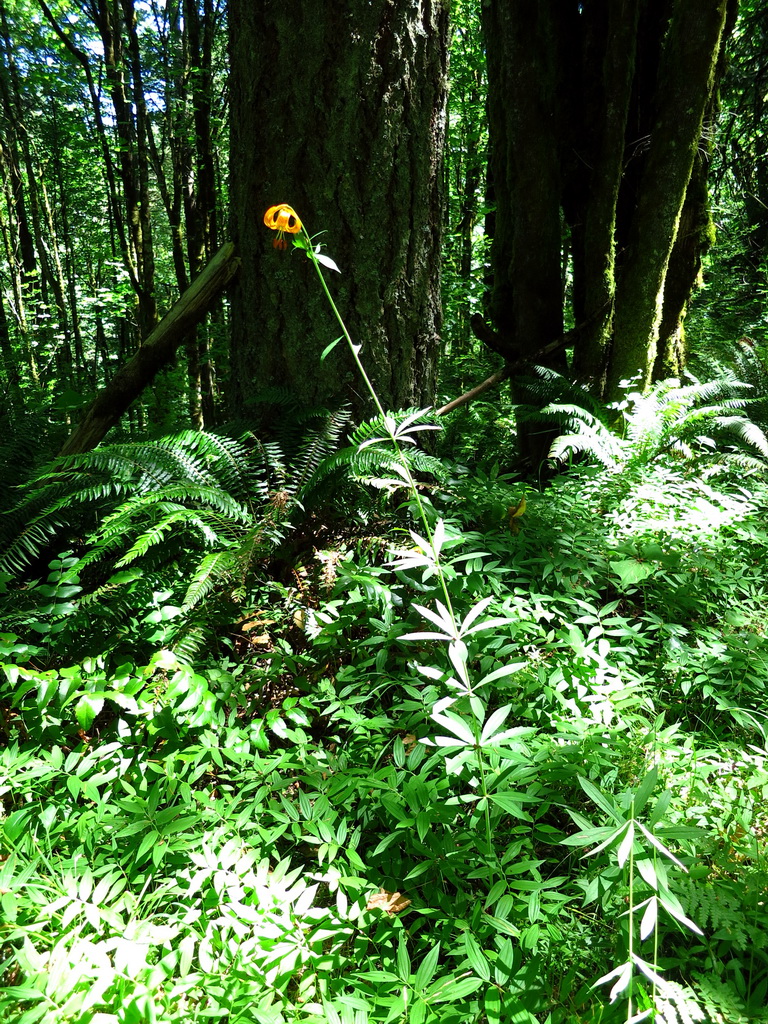
If you are out for a summer hike around Mt. Hood, Forest Park, or the in Coast Range, you will probably run into the Columbia Tiger Lily (Lilium columbianum). This striking orange lily is native to the west and the plant's peppery tasting bulbs were eaten by some local Native American tribes. The common name is from the flower coloring; I did not find the original Native name for this plant. The Latin name comes from where it was first collected (Columbia River).

It grows in open sunny areas and partially shaded cover. The stems can reach 5 feet, with multiple flower buds. Deer seem to relish the buds, but they are not suitable for human consumption!

Oddly, there is no mention of the Tiger Lily in the Lewis and Clark journal. They did take samples of the Wood Lily in October of 1804, but that was further east, on the Missouri River.

These were growing along the BPA road in Forest Park on 6/28/2013. Thanks to Ken D. for alerting me to this bloom!


Meadow Checker Mallow

The Meadow Checker Mallow (Sidalcea campestris) is similar to the Oregon Checker Mallow described earlier in this blog. It is fairly uncommon though, so I was surprised to see it growing at Bald Peak State Park in a small open area. 6/29/2013.


Larkspur

Larkspur is one of 300 species of Delphinium, a flower that is familiar to many. Here in western Oregon, you will probably see the Menzies Larkspur (Delphinium menziesii). The name Delphinium is from the Greek word "dolphin," and refers to the shape of the blossoms. The deep blue color of the flowers is a great sight amidst a sea of dry grasses.

Don't be picking these beauties for your summer BBQ table though, because all parts of these plants are considered toxic to humans, causing severe digestive discomfort if ingested, and also skin irritation. Tall larkspur in particular is very toxic to cattle and ranchers will delay moving cattle into fields that have larkspur.

The larkspur below are growing at Bald Peak State Park, in a small clearing at the south end. 6/29/2013.


Tuesday, July 2, 2013

Diamond Lake

Mt. Thielson from the North side of Diamond Lake
On my recent trip to Southern Oregon, one of my stops was at Diamond Lake, which is about 14 miles north of Crater Lake. This natural alpine lake is about 3000 acres in size and sits at 5,100 feet elevation. My two reasons for going to the lake was to 1) ride around it on the 11 mile bike path, and 2) to check out the wildflower blooms!

The lake is very popular with campers and fishing boats. One side of the lake is highly developed with a huge campground and a resort with hotel rooms. You won't really be getting back to nature on this side!

In spite of that, the bike ride was very pleasant and mostly flat. The route takes you though a wetlands, a dry ponderosa pine forest, and quite a bit of lakeside. The day I rode the trail (6/22/2013), the weather was very nice: no wind, mostly sunny, and warm temps. However, there were plenty of mosquitos along the trail. Stopping for pictures was a challenge, but I did have repellent!

The wildflower bloom had started a few weeks earlier this year due to warmer weather. I did not see any snow along the path. Here are some of the sights and wildflowers from the ride:

A crystal clear feeder creek for the lake.
Bike trail bridge over the creek.

 Bog area south of the lake. Lots of mosquitos here!

Azure Penstemon - Penstemon azureus

Tall Bluebells - Mertensia paniculata
 
Marsh Marigold - Caltha leptosepala
 

Few Flowered Shooting Star - Dodecatheon pulchellum

Sulfur Flower - Eriogonum umbellatum

Yellow Salsify - Tragopogon dubius
 
Likely: Blue Elderberry - Sambucus nigra Subsp. cerulea


Monday, July 1, 2013

Hedge Nettle

The Hedge Nettle, also called Great Betony or Cooley's Hedge Nettle (Stachys cooleyae), is a member of the Lamioideae (Mint) family; you can see this by looking closely at the leaves. This native grows up to 3 ft. high and has stylistic purple trumpet flowers. We found these growing in a mostly shady clearing at Noble Woods Park, 6/27/2013.

There are several varieties of Hedge Nettle growing in Oregon, and they all seem to have a history of medicinal/herbal uses. I found several references to using the plant's tea for heartburn, diarrhea, breathing problems, headache, and gout. Wow, who knew?!

The "nettle" part of the name appears to be a misnomer, because the plant is not in the Urtica genus and the plant does not have skin-breaking filaments with toxins.


Klamath Weed

Even if you lived in downtown Portland and never went to a park, chance are you would find the Klamath Weed (Hypericum perforatum). Also called St. John's Wort, this noxious weed has attractive flowers and grows just about anywhere, including along sidewalks in town! The plant's name refers to the tiny purple dots along the edges of the flower petals. The weed is mildly toxic, so don't be making salads with this one!

You've also probably seen the hybridized version of St. John's Wort, which you can buy at the garden store. It's very hardy and can be seen in landscaped areas along roads in our area. See photo 3 below. The flower is about 10 times bigger than the original.

These are growing along Laurelview road near our home. 6/20/2013.