Wednesday, March 12, 2014

Red Dead Nettle

In March, we try to get out for a walk with the dog whenever the weather here in western Oregon is good (i.e., not raining)! Today, the first day of daylight savings time, we saw a dry, warm (62 degrees) afternoon, so off we went. As I was walking by our neighbor's last year's garden plot I noticed a fine carpet of purple plants sticking up about five inches out of the tilled ground.

This caught my eye, so after the walk I came back to take a closer look. Well it was an easy ID time because these Red Dead Nettle (Lamium purpureum) are very distinctive looking and tend to grow in moist, disturbed areas. The purple and green heart shaped, mint-like leaves and the tiny purple flowers are unique.

These plants are quite hardy and can bloom any time during the year, even in mild winters. Although called nettles, the leaves do not produce a toxic venom as does the Stinging Nettle. True nettles are in the Urtica genus, which is not related to Lamium (Mint family). Hence the name "dead" nettle, meaning no sting!

Red Dead Nettle is native to Europe and Asia, and is considered an invasive weed in some areas of North America. I found several references stating that it is good in salad or as a tea for the treatment of internal and external bleeding. Just make sure the plants have not been sprayed with weed killers!


Sunday, March 9, 2014

Winter Speedwell

Here's another (late) winter blooming wildflower that has shown itself recently in early March, 2014.

Last October I posted about a tiny blue flower called American Speedwell. Today's post is about one of the other Speedwells, with a very similar small blue flower. Winter Speedwell (Veronica persica) is also called Bird's Eye and Persian Speedwell and grows in nearly every state. In some areas it is regarded as a weed. But then as Ralph Waldo Emerson said,

“WHAT IS A WEED? A PLANT WHOSE VIRTUES HAVE YET TO BE DISCOVERED.”

Winter Speedwell blooms in late winter in our area but can be hard to spot due to its small size. We found a few growing just off our gravel road, on a southern exposed berm. The colorful blue flowers have four petals and are only about 1 cm wide.

The name is derived from the story about a young girl (later canonized as St. Veronica) who wiped Jesus Christ’s face with Speedwell flowers on his journey to Calvary. As the story goes, healing properties were then absorbed by the plant. 

I found a few references to using Speedwell as an herbal tea expectorant, but it was not clear as to which exact species, so don't go boiling this one; stick to your favorite Stash tea!


Photo taken March 3, 2014

Photo taken March 3, 2014


Saturday, March 1, 2014

Winter Aconite

Our weather forecasters here in the lowlands of western Oregon are saying that Winter is pretty much over - and that of course is music to my ears! That means the wildflower exploration season is starting to roll. A trip to Jenkins Estate supports this notion, so I'll once again be keeping the camera and trail gear handy.

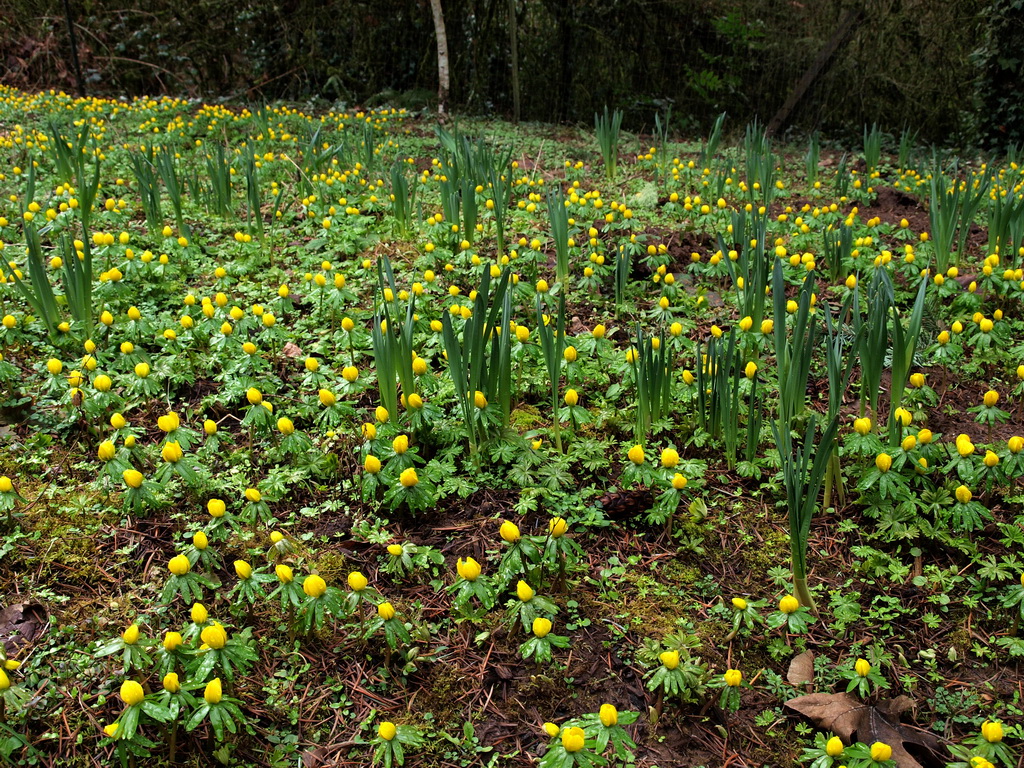
Last Fall, we admired the large colonies of Wild Hardy Cyclamen growing under the old growth conifers, behind the main house. Now, in the third week of February, the Snowdrops and and a web of yellow blossoms got our attention.

Apparently this colorful ground cover is often one of the first to show itself in late Winter or early Spring. I had never seen it before taking the photos below, but to me the leaves resembled our creeping buttercups we see later in Spring. It took a couple of weeks, several emails and calls to the grounds keepers to determine that Winter Aconite (Eranthis hyemalis) is the identity of this mystery plant; and it is indeed a member of the Buttercup family (Ranunculaceae).  It is native to southern Europe but has been naturalized in most of the U.S. It grows from tubers and thrives is moist, but sunny areas common under deciduous trees before their leaves appear. Hyemalis means "winter-flowering."

The common name is misleading in that a very different, unrelated plant called Aconite (or Monkshood in our area) shares the same name. This Aconite (Actonium napellus) has a blue flower on stalks and is extremely poisonous!

We found these blooming (3/01/2014) at Jenkins Estate, near the koi ponds behind the main house.

Fully opened flower is about 1.5 inches across.

Leaves are about 2 - 2.5 inches across.

These have been here for a while.


Witch-Hazel

If you run an internet search for Witch-Hazel, all kinds of interesting things pop up! And if you have lived around Hillsboro for a while, then you know there is a Witch-Hazel Elementary School in town. According to Wikipedia, the area where the old school was located was an unincorporated area of Washington County, called Witch Hazel, after a race horse. See the link below for more on the history of this area.

Most old people have heard of Witch-Hazel, the liquid astringent sold in stores since before there were drug strores. It is said to be better than rubbing alcohol for external scrapes and maladies - I have never tried it myself, but it has been around since Native Americans shared it with the colonists in the 1600's. These products are derived from the leaves and bark of the Witch Hazel shrub (Hamamelis). See the link below for more Witch-Hazel uses.

There are three species of Hamamelis that grow in North America. They are deciduous shrubs that are unique in that their flowers bloom from the prior year's fruit. You can see that in the photos below. The genus name comes from the Latin word for "together with fruit."

I spotted two of these shrubs blooming at Jenkins Estate (2/21/2014) - one yellow and the other orange. The first, Homamelis virginiana, is native to the Northeastern U.S., and the second is native to China and is widely planted as a garden ornamental that blooms in winter. The blooms remind me of Medusa, the Greek goddess, that would turn you into stone if you looked at her. Could be why I have never tried the astringent...


Hamamelis virginiana

Hamamelis virginiana

Hamamelis mollis

Hamamelis mollis


You can get this for only $2.99!


Witch Hazel Plant

Witch Hazel Area History

Witch Hazel Astringent History

Witch Hazel Astringent Uses


Saturday, February 22, 2014

Helleborus

Think of being stuck on a long plane ride, next to a guy who talks non-stop, mostly about himself. And he's not that interesting; you just want to go to sleep and he keeps talking...

The word that comes to mind for this person, in this situation is "Helleborus." It's a real word, but of course it is the name of a genus of flowering plants native to Europe, the Ukraine, and Turkey. The greatest concentration of native Hellebores is in the Balkans. It's a hardy evergreen and yes it grows well here in western Oregon. In fact it is starting to bloom now (2-20-2014).

My mother Jackie was an avid gardener and hardly a day went by where she was not out in the dirt, pulling weeds or planting something. When she and her husband Bruce retired in Medford in 1992, they bought an older home with a large yard for gardening. The yard's many species included several varieties of Hellebores. We were not familiar with these winter-blooming plants, so at some point she dug up some of the plants and we brought them back to our place and planted them. She passed away in 1998, but the transplants are going strong in a shaded cluster on the north side of our house.

Some of the common names of the 20 or so species in this genus are Christmas Rose and Lenten Rose, due to the time they usually bloom. They are not related to the Rose family at all, but no matter in the fickle world of common names. I believe the ones in our yard are Lenten Roses (Helleborus orientalis), but this year they seem to be very early.

Most Hellebores are highly toxic but nevertheless were used (centuries ago) as treatments for a wide range of ailments including leprosy! Interesting Hellebore legends from Wikipedia:
  • Helleborus niger is commonly called the Christmas rose, due to an old legend that it sprouted in the snow from the tears of a young girl who had no gift to give the Christ child in Bethlehem.
  • In Greek mythologyMelampus of Pylos used hellebore to save the daughters of the king of Argos from a madness, induced by Dionysus, that caused them to run naked through the city, crying, weeping, and screaming.
  • During the Siege of Kirrha in 585 BC, hellebore was reportedly used by the Greek besiegers to poison the city's water supply. The defenders were subsequently so weakened by diarrhea that they were unable to defend the city from assault.
  • An overdose of medication containing hellebore has been suggested as a possible cause of the death of Alexander the Great.
Although somewhat similar in appearance, this plant is not related to False Hellebore, which is a wildflower we found blooming near Lookout Mountain last summer. The flowers are about 1.5 inch wide and have five sepals rather than petals. The sepals, which retain the flower's nectar, remain on the plants for months, thereby helping with more successful seed production. The leaves are large, about 6 inches long, and dark green. Clusters of buds appear as the plant begins to flower. Many hybrid strains are available from garden shops, and there are many internet sources for these hardy evergreens.


At Jenkins Estate - 2/21/2014


Thursday, February 6, 2014

Moss Art

The temperature today is 18 degrees, it's snowing, and the east wind is blowing....


That may sound like Purgatory to you and I'm inclined to agree, except that this climate means I can sit at the computer and catch up on some photo editing and writing. Looking out the window at the blowing snow as I write this, gives one time to reflect as well, a necessary ingredient for planning fair weather explorations in the coming months.

Meanwhile, as this is the "off-season" so to speak, here's a half-price post for your viewing pleasure and for me to keep my old brain engaged...

If you spend any time in the Pacific Northwest, at some point during your visit you will realize that no matter where you go, you can count on three things: espresso, craft beer, and moss. Those of us who live here eventually become blind to the moss in the forest, as it just fades into the background like your boss's long speeches. On the other hand, some people spend a fortune trying to get rid of moss in their lawns and on their roofs.

Nevertheless, moss can have a subtle yet special beauty of its own. This winter in particular, it seems like the moss is working overtime: there seems to be more of it and it appears more colorful and lush. I'm guessing that is due to our very dry winter with lots of sun and ample fog to allow for growth. That, coupled with the fact that there are just a handful of wildflowers blooming in winter, inspires me to do this post, basically on the subtle photographic qualities of moss.

Much has been written about moss in general, so I won't repeat any of that here. That said, here are just a few interesting facts about moss:

  • Moss is one of the oldest plants on the planet.
  • There are about 12,000 species of moss in the plant division Bryophyta.
  • Moss is non-vascular, meaning it has to absorb moisture directly from precipitation.
  • It does not have roots, flowers, or seeds.
  • In summer, moss can reduce its metabolism drastically to survive in the dry weather.
  • Spanish moss is not really moss. It's a lichen.

Ok, on to the photos. These were all taken at Rood Bridge Park in January 2014. 

For my complete gallery of my spellbinding moss pictures, visit: Clark's Moss Gallery on Zenfolio.


Saturday, February 1, 2014

Snowdrop

Happy new year everyone!

It's been slow in the wildflower sighting club lately, so we have been mostly picking up trash on our local walks at the park. The weather this January was well below normal in precip and higher in sunshine, so we have seen lots of moss - seems to be the ideal conditions for it this winter.

In any event, this post is to commemorate the first sighting of a local wildflower this year! Yee-Haw!

It's the winter-blooming Snowdrop (Galanthus). These small white blooms (about 3/4 in. tall) are one of twenty species found in Galanthus. Many cultivars also exist so it's hard to say if these growing along Laurelview road near a ditch are wild or not. These are probably Galanthus nivalis, the most common species in most areas. Galanthus are native to Europe, where they are threatened, due to loss of habitat.

Interesting note from Wikipedia: It was suggested by Andreas Plaitakis and Roger Duvoisin in 1983 that the mysterious magical herb "moly," that appears in Homer's Odyssey, is actually Snowdrop. An active substance in snowdrop is called galantamine, which, as anticholinesterase, could have acted as an antidote to Circe's poisons. 

Snowdrops at Jenkins Estate (2-21-2014)

Fully opened blossom at Jenkins Estate

On Laurelview Road (2/01/2014)