Sunday, May 15, 2016

Urban Nature

The first "public park" in the U.S. was the venerable Boston Common. Its land was purchased in 1634 for military training and cattle grazing. Thankfully, by 1640 the 50 acre Common was promoted to an actual park and has been used for public enjoyment since then. Although it has had a colorful past, it now a top destination for locals and visitors alike.

Near Columbus Circle
Likewise, New York city's Central Park is a park with a rich history. On a recent trip to the city, I had the pleasure of enjoying a bike ride around Central Park. It was a great way to explore the 840 acre spread and we were there at a good time for flowers, both wild and not so wild! I rented a well-used "comfort" bike at Columbus Circle and spent a couple of hours exploring the miles of roads and trails. There were many others out and about on foot and on bikes but it was not crowded. The park has so many distinct areas and is so large, one could spend days getting to really know it.

The park has a fascinating history of ups and downs since 1857 when it was first set aside. With the exception of the large granite rock formations, none of the park's many areas are native lands; it was designed and built entirely by humans - but it has been around for so long, portions of it have become naturalized. Locals love the park and I can see why: it has something or someplace for just about everyone. 

As with many nature spaces these days, Central Park is operated and maintained by a non-profit conservancy in partnership with the city. According to their website, this has led to greater funding and a long term approach to the health of the park. And rightly so - it is the most visited park in the U.S, with 40 million visitors in 2013.

In addition, the trend for public nature parks as another "menu option" to traditional city parks continues to evolve. It is encouraging that our civic leaders are recognizing the need for both formal, structured multi-use parks as well as true nature parks, with native plants and animals and minimal human impact. Central Park has an "embedded" four acre nature park called the Hallett Nature Sanctuary. It was restored in 2001 by removing invasives and adding trails. Since then it has evolved into a limited use example of natural restoration. Unfortunately for me, it was closed at the time of my visit, so a return trip is in order.

You can read more about Central Park from the links below. Here are a few photos from our brief stay in New York city in late April of this year.


These native Virginia Bluebells (Mertensia virginana) were blooming all over the park:


It is unlikely a cougar ever roamed this area, but this one keeps
a close eye on wayward visitors...


In one area you can enjoy carefully landscaped tulips,
while these native violets are growing here and there along foot paths.


The North Woods section resembles a typical northeastern forest and is
largely naturalized. The hybrid cherries were blooming throughout the
grassy areas.


Honesty (Lunaria annua) was showing its stuff along the trails, but there is only 
one obelisk in the park. You'll have to visit London to see the other.*


The Lake is one of several water features in the park. On this warm
April day, visitors were enjoying lunch hour.


Native shrubs bloom in the North Woods, while ornamental
crabapples please humans, canines, and bees alike!


Links:


Tuesday, April 12, 2016

The Usual Suspects

As our Spring really gets rolling, we go outside more - the days get longer, the temps warm up, and before you know it, plants, trees, and shrubs are growing and blooming everywhere you look. Those nice trees are also casting buckets of pollen in their quest to secure a future - but that's a whole different post!

In the past week we've seen trillium, fawn lily, wild iris, and the dainty stream violet - all natives, putting on an impressive colorful show. But as usual, there are some uninvited guests at this party! This time of year, most are low-lifes, meaning they hug the ground to avoid detection by spray wielding gardeners! A few of these party crashers are actually natives, but most are not. Even so, their flowers are attractive and you can easily be seduced by their subtle beauty, so beware! Captain Louis Renault would know exactly what to do in this situation...

Here's a "roundup" of the suspects you might see lurking around your favorite trails.

Purple Dead Nettle (Lamium purpureum)

You've probably seen this stuff growing in parks and lawns just about anywhere in the area. It can form huge colonies and has tiny pink flowers. Fortunately for you and your dog, these nettles do not sting. Non-native.


Storksbill or Filaree (Erodium cicutarium)

This invader has been successful along our country roads where we live. When the dime-sized blooms are out, the non-native makes an attractive ground cover for a few weeks and is common throughout the west. The blooms close up by mid-afternoon, so it must have a good internal clock.


Rock Purslane or Red Maids (Calandrinia ciliata)

Another ground creeper with tiny purple flowers, this native weed could pass for a desirable plant in some circles. In the wild, it can create handsome swaths of color on a hillside.


Slender Speedwell (Veronica filiformis)

This cute suspect can easily go undetected as its flowers are so tiny. And with over 500 other related species, you'll never be far from a Veronica. Non-native.


English Daisy (Bellis perennis)

Tea and Crumpets anyone? Just about any lawn will be a good habitat for these little invaders. Most gardeners don't mind their visits, but a grass purist may disagree. The quarter-sized flowers close up when it's cool. They are non-native as the name suggests.


Dove's Foot Geranium (Geranium molle)

There are several "geranium" plants around the Northwest. Two are natives and the other three are not, which includes the Dove's Foot. This one is hardy and prolific, like the other suspects in this post, it can form large swaths, especially along partially shaded moist trails. The flowers are smaller than a dime, but the petals are lobed.


Hairy Bittercrest (Cardamine hirsuta)

In spite of the name, there is not much "hair" on this plant. But those big seed pods tower over the flowers as the plants mature. Non-native. Some folks harvest the fresh leaves for salads or soups, adding a peppery taste.


Well I could go on and on about these pesky plants and their rowdy relatives, but in all honesty they don't really bother me too much. One could say they are just another food station for our dwindling population of native bees.

Monday, March 28, 2016

Rowena Road Trip

The start of spring here at wildflower blog central is kind of like a school homecoming; we don't have a  royal court or a big football game, but the highly motivated staff returns to our base of operations, with big smiles, cameras, and hiking boots in tow. We supply good coffee, trail mix, and a boat-load of encouragement for the eager team. As we huddled around the outdoor firepit in the back yard, our first assignment of the season was revealed: Rowena Plateau. This notable spot is a geologic curiosity and a smorgasbord of native wildflowers throughout spring.

Gold Stars and Columbia River in Back
Fortunately this wonderfully scenic area, officially known as the Tom McCall Preserve at Rowena, is owned by the Nature Conservancy. With one trail winding through the grassland plateau and another going up a steep hill, there is ample exploration opportunity.

This year, our first visit to Rowena was on March 17, a clear, sunny, and somewhat windy day. We arrived before noon, so it was still cool enough for coats and long pants. We saw a herd of deer on the way up to the parking area but luckily no herds of people on this day at the Preserve.

Just steps from the trailhead we spotted carpets of the small and bright Gold Stars, along with large swaths of Grass Widows. The trail was a bit muddy from recent El Nino rains and many of the pools on the plateau were overflowing into small channels down the slope.


Gold Stars (Crocidium multicaule) and Grass Widows (Olsynium douglasii)

Further along we captured Columbia Desert Parsley, Gray's Desert Parsley, Prairie Stars, and Yellow Bells. This loop trail goes out by the cliffs, and has great views of the river and a bird's eye view of Lyle, WA. And speaking of birds, we saw Ravens, a couple of Turkey Vultures, and at least one hawk soaring in the drafts above us. We kept moving, so the vultures ignored us geezers.


Columbia Desert Parsley (Lomatium columbianum) and Gray's Desert Parsley (Lomatium grayi)


Yellow Bells (Fritillaria pudica) and Prairie Stars (Lithophragma glabrum)


On the return route, we encountered more deer, that seemed to be somewhat used to humans in the area. The few oak trees in this area have no leaves yet and a handful of pines are stunted and warped by the wind here.


After a lunch break in the comfort of a nice warm car, we head up the other trail on the south side of the parking area. To prevent damage, the trail is officially closed until May, when things dry out a bit. Instead, we take an old, rocky wagon road trail that skirts the east side of the mountain.

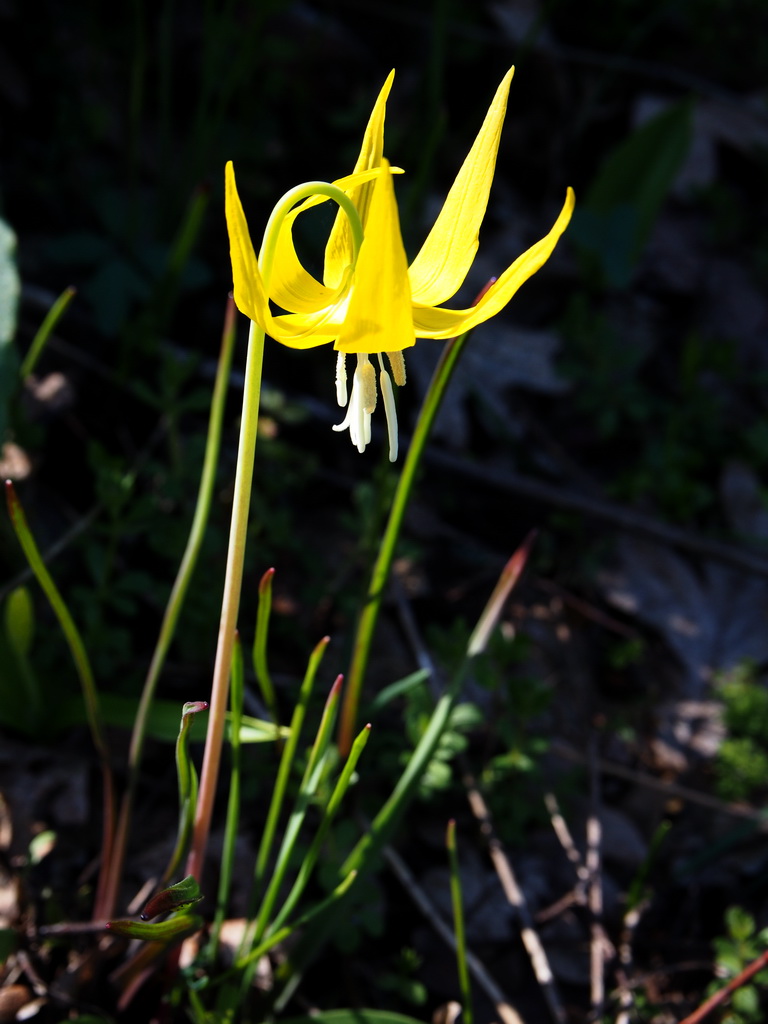
Here we find hundreds of Oaks Toothwarts, more Columbia Desert Parsley, and are surprised to find several blooming Glacier Lily on the sunny slopes. This area is much more treed, with oak at the start, transitioning to firs and pines as we gain elevation. For the next mile or so we see no other hikers on this obscure trail. We stop for a coffee break snack at a nice north-facing clearing, where we get a great view of Lyle, Rowena Crest, and Mt. Adams (Klickitat) in the distance.


 Glacier Lily (Erythronium grandiflorum) and Oaks Toothwart (Cardamine nuttallii)


The old wagon trail

Rowena Crest, Mt. Adams, and the Scenic Highway

After our rest-snack break, we pack up and head back down the trail where we are surprised to find another hiker coming up the hill. We arrive back at the trailhead around 3:30 PDT, ready to shed our boots and head back home.

Sunday, March 20, 2016

Sleeping Giant

Those of us who dwell in the Northwest are somewhat familiar with its volcanic past. Our Cascade mountain range is peppered with active and inactive volcanoes and school children in the area learn about many of them in class and with field trips. Crater Lake (Mazama) in southern Oregon is probably the best known volcanic site, or perhaps Mt. Saint Helens (Loo-wit) in Washington.

Paulina Lake in the Newberry Caldera
But you may not know that the largest Cascade range volcano is at Newberry National Volcanic Monument, near Bend, OR. It is so massive, it would cover the entire state of Rhode Island. And it does not look like a cone style peak. Rather, it has become a shield volcano due to repeated eruptions (more than 400,000) over its life. The latest eruption was a mere 1, 300 years ago and experts say it is still an active volcano that could erupt at any time.


Big Obsidian Flow
It's a fascinating place to visit, even if you are not a geologist. The various federal agencies who manage the 1,200 square miles of the monument and adjacent lands do an excellent job of making it available and providing interesting educational sites for the curious. We have visited the area many times over the years; in the fall of 2015 we spent a couple of days looking around the Newberry Caldera, which we had not done for about 10 years. The caldera is about 4 by 5 miles in size, with two large lakes sitting in it. The massive "Big Obsidian Flow" is here as well, covering several hundred acres.


Ponderosa Pine Struggles to Survive in Lava Flow
The expansive lava flows and the obsidian flows are extremely harsh environments for trees and plants, yet we can see a few of them making a go of it as we walk the lava trails in the monument. Outside the lava, in this high desert land and the surrounding areas of soil, millions of lodgepole and ponderosa pine thrive in the extreme cold winters and very hot, dry summers. The place is a true testament to plant evolution for survival. Read more about these pines at Northwest Conifers.


In the northern part of the monument, Lava Butte and the visitor center serve as a good location to get your bearings and take in a 360 degree view of the area. There is a working fire lookout as well as a small parking area and a trail to explore the Lava Butte cinder cone. You'll see many square miles of lava that has spewed out of the cinder cones in the area. Several trails allow you to safely enter the lava fields.


As harsh as it is, the lava supports several hardy native species, such as Rabbitbrush (Ericameria nauseosa), Manzanita, Ponderosa Pine, and the rare Cusick's Monkeyflower (Mimulus cusickii).


Manzanita and Ponderosa Pines on the south side of the
 Lava Butte cinder cone.

Marsh Forget-Me-Not (Myosotis scorpioides) along the
Deschutes River at Lava Lands

The monument is named for Dr. John Strong Newberry, an American geologist, physician, and explorer who lived from 1822 to 1892. Oddly, it is unclear if he ever visited Central Oregon during his vast career. But YOU can visit and explore this fascinating area almost any time of year!

Deschutes River and Lodgepole Pines

Sunday, March 6, 2016

Shrub Club


Plum tree and willows at Jackson Bottom Wetlands
If you've been out and about in the past week or so, you've noticed a plethora of flowering shrubs and trees all over the area. The ornamental plums, cherries, camellias, and quince are exploding with their bright colors. An army of bees were making the rounds on our trees, having been diverted from the crocus and daffodils. It's a fitting farewell to winter, although our winter here in the western Oregon lowlands was very mild. In fact, we have not had a freeze since January 8th.

"So what about our native plants," you ask? None of the plants mentioned above are native, but there are a few natives starting to show their blooms. While walking around a couple of our nature parks in the last week we spotted Indian Plum, Red Currant, Willows, and Tall Oregon Grape. These shrubs are typically among the first to bloom in spring and they seem eager to please this year. And they also signal the start of the season for us wildflower watchers - always an uplifting moment! Here's a quick look at those "early birds."

Indian Plum - Oemleria cerasiformis


This plum is native! Also known as osoberry, the ripe fruits were eaten by native peoples from time to time. Before ripening they were also used as an astringent. The plant stalks could be used on skin sores after being mashed.


Red-Flowering Currant - Ribes sanguineum


In spite of the common name, the colors on this native range from white to pink to red. It also has berries, but they are inedible. The blooms are popular with hummingbirds as well as bees. The Scottish explorer-naturalist, David Douglas, sent this plant back to Europe where it was used extensively as an ornamental. These two photos show the range of color for the blooms.


Willow Shrubs - Salix sp.


Willow shrubs are excellent plants to use when restoring wetlands or riparian areas. They are very hardy and they do well in wet soil. In addition, they do well when competing with non-native species. In the photo below you can see all the willow "blooms" at Jackson Bottom Wetlands on 3/04/2016.


Taking a closer look at the "blooms" reveals a catkin rather than a true flower. The photo shows the male pollen-bearing anthers extended. This allows insects to drag pollen from the anthers to the female catkin, which typically forms a bit later. Interestingly, willows do not rely on wind to transport the pollen - just insects. Which explains why they do well in bug-infested wetlands!


Tall Oregon Grape - Mahonia aquifolium


Way back in 1899, this northwest native was designated as the official Oregon State plant. We've seen this popular plant in natural areas as well as business parks and suburban yards. It's hardy, has a striking bloom, is evergreen, and produces colorful blue berries - suitable for making jam or your own ink if you are so inclined. It typically blooms later in the month, but these we saw at Jackson Bottom were already starting to open.